Project

LifeGPT

Topology-agnostic GPT for Conway's Game of Life; published in npj Artificial Intelligence.
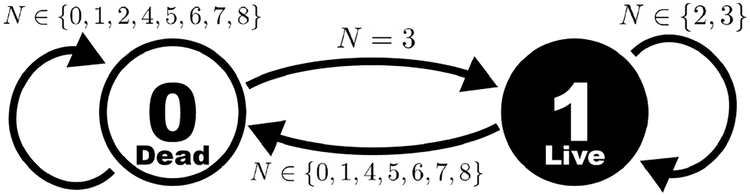
LifeGPT paper figure showing Conway's Game of Life state transition setup
Figure: LifeGPT setup for learning one-step global state transitions in Conway's Game of Life.

LifeGPT is a decoder-only GPT model with rotary positional embeddings and forgetful causal masking that learns to compute a single-timestep global transition in Conway's Game of Life on toroidal grids. The paper emphasizes a topology-agnostic sequence model rather than a convolutional architecture that already encodes grid locality.

Paper takeaways

  • With sufficiently diverse training data, LifeGPT achieves near-perfect accuracy at the one-step next-game-state task.
  • Recursive simulation is possible by feeding predictions back into the model, but small errors can compound into divergent rollouts.
  • A multigrid experiment trains on 2, 4, 8, and 16-cell-wide toroidal grids while retaining near-perfect test accuracy.

Results that matter

  • LifeGPT approximates Conway's Life extremely well, but the paper explicitly notes that it does not exactly replicate the algorithm in all recursive cases.
  • The 16 by 16 multigrid setting still exceeds 99.94% average accuracy, while smaller tested grids are inferred perfectly.
  • Ruleset inference from real-world data is proposed as future work, not presented as a completed result in this paper.